
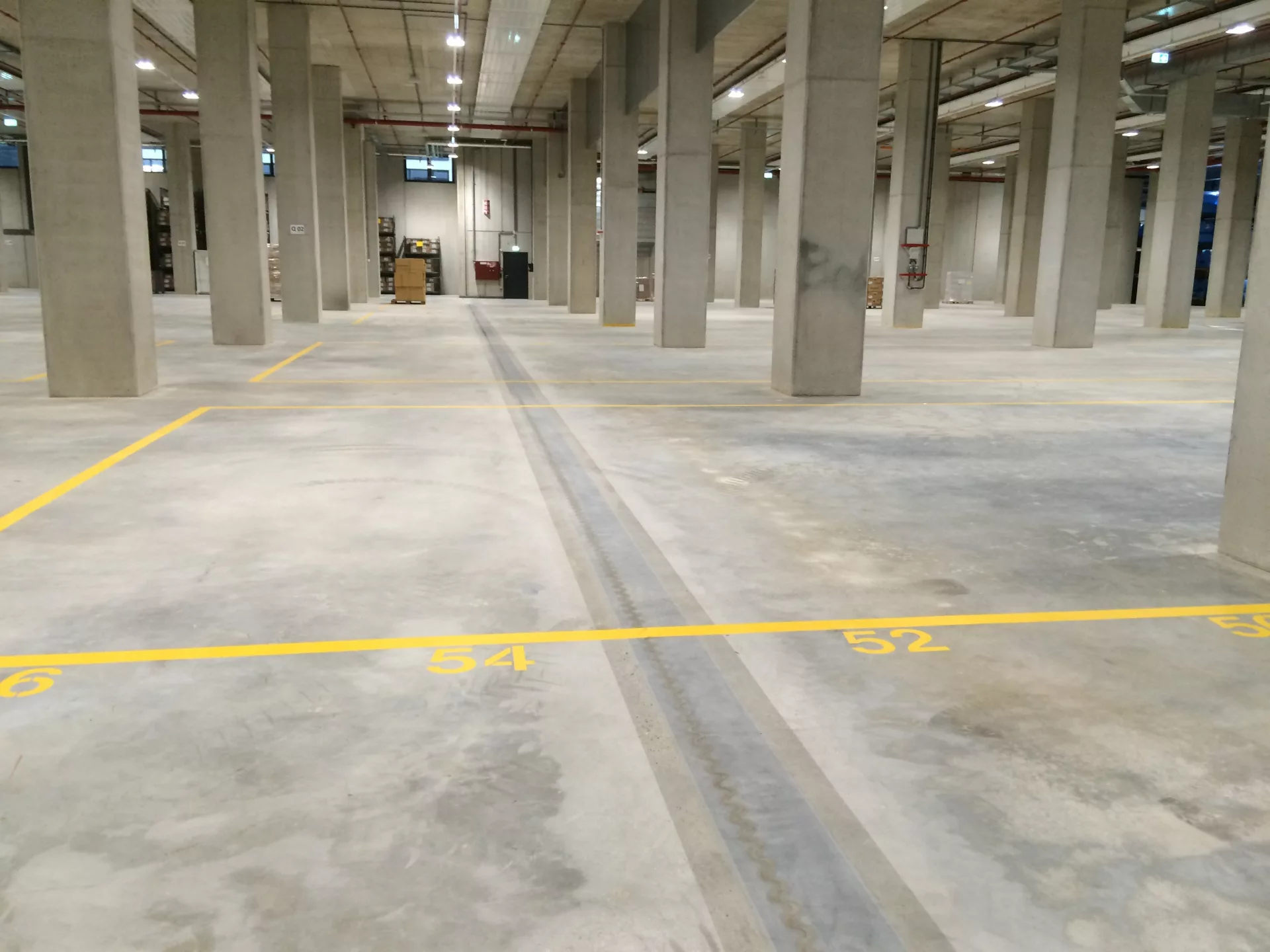
About Warehouse Construction
Warehouse construction concrete scope from our crews means one accountable concrete package from site development through slab completion. We deliver complete concrete packages for distribution centers, manufacturing facilities, and logistics operations—foundations, slabs, truck courts, loading docks, and sitework—self-performed by one crew whether we're bidding the scope as a subcontractor to the project's general contractor or contracting directly with the developer.
In the DFW logistics corridor, warehouse development continues to accelerate as e-commerce and supply chain investments drive demand for modern distribution facilities. As your concrete contractor, we self-perform the full concrete scope: earthwork and grading, foundations and footings, floor slabs with specified flatness tolerances, dock approaches, truck courts, and curb and gutter. You work with one concrete crew from estimating through closeout.
Floor flatness and levelness (FF/FL) numbers matter in warehouse construction. Very narrow aisle (VNA) operations may require FF50/FL50 or higher, while standard distribution centers typically need FF25/FL35. We work with your rack vendor and operations team to specify the right tolerances, then verify performance with third-party testing before turnover.
Joint design is equally critical. Warehouse floors see constant traffic that will deteriorate poorly-designed joints within years. We specify armored joints, proper load transfer devices, and joint spacing optimized for your specific equipment patterns. This attention to detail during construction prevents the expensive repairs and operational disruptions that plague facilities built to minimum specifications.
What’s Included
- Pre-construction soil and subbase evaluation
- Laser-guided grading and subbase preparation
- Vapor barrier installation
- Reinforcement placement (rebar, fiber, or combination)
- High-precision concrete placement
- Power trowel finishing to specified tolerances
- Control joint sawing on optimized layout
- Armored joints at high-traffic locations
- Third-party floor flatness testing
- Cure and protect procedures
Frequently Asked Questions
What floor flatness specifications can you achieve for warehouse slabs?
Our crews regularly achieve FF35/FL30 for standard warehouse applications and FF50/FL50 for very narrow aisle (VNA) operations. We verify floor flatness with independent testing and can provide certified floor survey results as part of project closeout.
How do you handle joint design for high-traffic warehouse floors?
We design joint layouts based on expected traffic patterns and equipment. Typical warehouse floors use a combination of saw-cut contraction joints at 12-15 foot intervals and armored construction joints at larger spacing. For high-traffic areas, we recommend load transfer devices (dowels or plates) to prevent differential settlement.
What concrete thickness is required for distribution center floors?
Most distribution centers in the DFW area require 6-7 inches of concrete slab thickness over properly prepared subbase. Heavy manufacturing, rack storage with high point loads, or forklift traffic exceeding 10,000 lbs may require 8+ inches. We calculate required thickness based on your specific load requirements during design.
Can you install floor hardeners or sealers as part of the slab installation?
Yes. We offer shake-on floor hardeners applied during finishing for heavy-traffic warehouses, densifiers and sealers for dust-proofing, and polished concrete finishes for showroom or office areas within industrial buildings.
How long before we can operate on the new warehouse floor?
Light foot traffic is typically permitted after 24-48 hours. Forklift and equipment traffic should wait 7-14 days depending on concrete strength gain and ambient conditions. We provide specific cure time recommendations based on your mix design and planned operations.